Mayagüez, by inheritance
Henry Cole was born in Mayagüez in 1979 and grew up between Mayagüez and Añasco; Villa Locura, the band he leads, takes its name from the Añasco neighborhood where he spent his childhood. In his family, music came with the surname. His grandfather, Benjamín Cole, was mayor of Mayagüez for twenty-four consecutive years. His great-uncle Roberto Cole was a composer. His grandmother, Angelina Simón, directed the choir of the Candelaria church in Mayagüez for more than seventy years, a tradition begun by her father, Enrique Simón, a Cuban flutist born in 1865 who taught music to all twelve of his children. His father, Henry Cole Simón, was a violinist and a teacher. Henry began piano at four and drums at nine, and trained at the Escuela Libre de Música in Mayagüez.
A theater, and an invitation from 1937
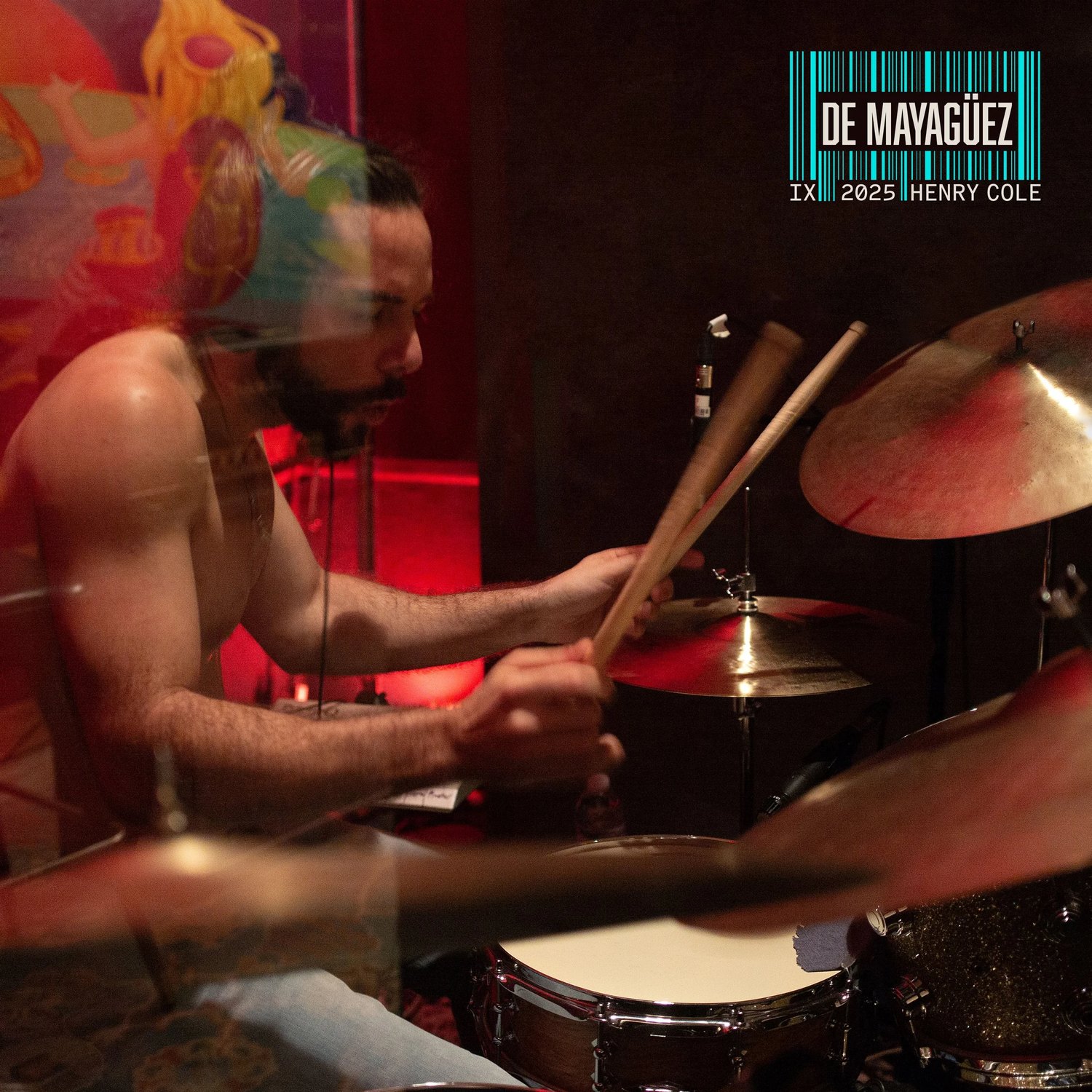
Going through boxes his father had left in a basement, Henry found an invitation to a 1937 concert by the Cole-Simón duo, two of his relatives, at the Teatro Balboa in Mayagüez. That is where he decided the album would first be heard. On November 8, 2025, the Teatro Balboa Armando ‘Chucho’ Avellanet presented De Mayagüez, una experiencia sonora: the record played to an audience in the theater, with photographs from the recording sessions on the screen, which Henry described as a concert without musicians and a film without visuals. The night’s ticket proceeds were pledged to Casa Cultural Estudio 353, a space for creating and preserving Puerto Rican bomba.
Electric Lady, summer 2015
The album was made in three summer days in 2015, plus two more for voices and finishing touches, in Studio A of Electric Lady, the room built for Jimi Hendrix in Greenwich Village. Phil Joly recorded it, Michael Brauer mixed it and Joe LaPorta mastered it; Henry produced it with Jason Lindner and Phil Joly. He chose the studio, he told the writer Ned Sublette, for what he calls its ‘culture of greatness’, one that reached the interns and the cables: making every take a great take was the job of everyone in the building, not only the artists.
Ten years, and a fire
Then the music waited. On September 9, 2018, a fire destroyed Henry’s apartment in New York and most of what he owned; the date is in the title of one of the album’s tracks, ‘En Paz (September 9, 2018)’. He stayed for a few weeks with Pregones, the Puerto Rican theater company of New York, ran his credit card to the limit, finished mixing the album, and came home to Puerto Rico, where he has lived since. That year he also founded Escuelas en Ritmo, which takes live music and rhythm workshops into the island’s public schools. In the words of the writer Rita Indiana: ‘After surviving a fire in his New York apartment, Cole has returned to the island, and as this record hints, he’s back for good.’
What is proper to a place
In the liner notes, Ned Sublette calls the album makisi nsi, the term the Cuban scholar of Kongo thought Bárbaro Martínez Ruiz uses instead of ‘traditional’: what is proper to a place. In its sound, Sublette writes, the record belongs to New York and to Electric Lady; in its content, to Mayagüez. Even bomba, which he calls the most makisi nsi of Puerto Rican musics, is a crossroads of rhythms from across the Afro-Antillean world, played differently in different parts of the island, and ‘Mayagüez has its own styles.’ Henry describes his music as mestiza, like the island’s culture and like his own upbringing, and this album as not only Puerto Rican but very Mayagüez, very much of the west.
The voices
Tito Allen sings ‘El Diablo’, the Rafael Hernández song. For thirty years he had turned down every request to record it again, because it already existed with Ray Barretto; this is its second recorded version. Tego Calderón wrote and sings ‘Caminando’, and it was Tego, in the studio and unprompted, who first brought Mayagüez into the record; Henry says that is when he realized the album was a homage to his city. ‘Agripina’, the first single, is a plena by the Mayagüez singer-songwriter Kily Vializ, who sings it here. Cristy Mangual, the voice of Mayagüez bomba, said yes once she placed the family: Henry’s father, she told him, once pulled her braids at the Escuela Farragut. Andy Montañez closes the record with ‘Atiende’.
If tonight sent you looking
His albums as a leader:
With the Miguel Zenón Quartet, whose drummer he has been since 2005: Vanguardia Subterránea, nominated for the 2026 Grammy for Best Latin Jazz Album. He played drums on Calle 13’s Entren Los Que Quieran, which swept the 2011 Latin Grammys. To read: Ned Sublette, Cuba and Its Music: From the First Drums to the Mambo (2004).