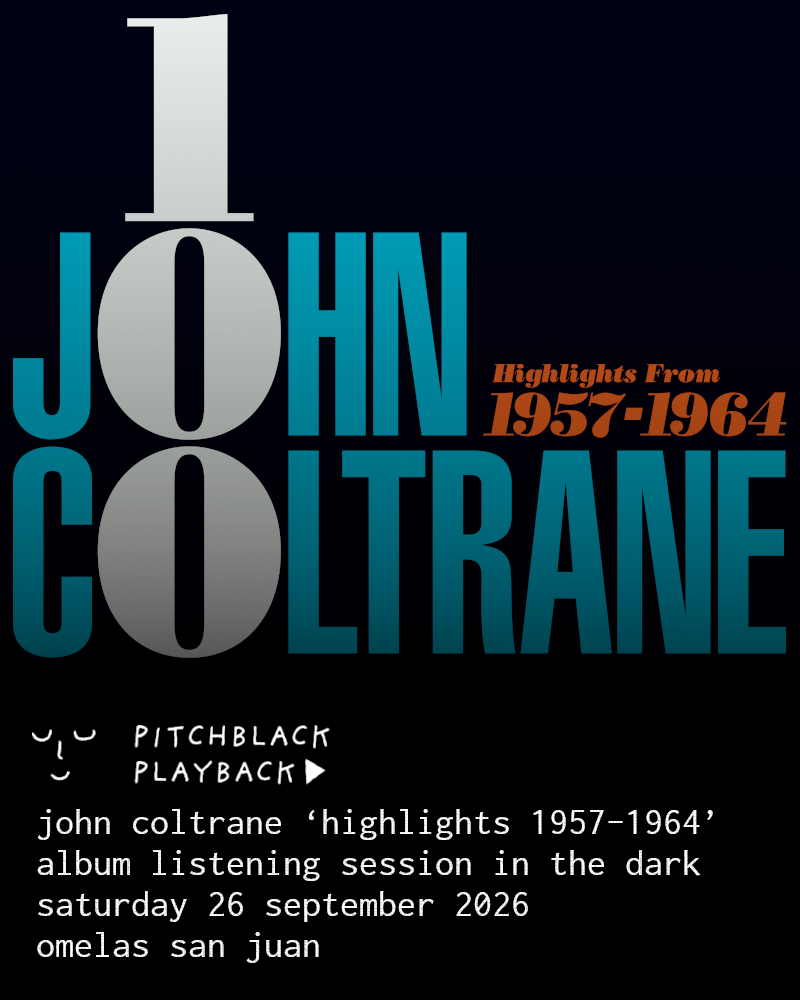
One hundred years
John Coltrane was born on 23 September 1926 in Hamlet, North Carolina, and this session fell in his centenary week. He died at forty, in July 1967, having moved through more music than most players do in a lifetime: the Prestige sideman dates, a summer with Thelonious Monk, the two great Miles Davis bands, his own quartet, and the late, open music that still divides rooms. Every one of the eleven tracks we heard tonight was recorded from May 1957 onward. What happened that month is the hinge of his life.
The road to 1957
He grew up in High Point, North Carolina, in a house that emptied when he was twelve: his father, his grandfather and an aunt died within a few months of each other in 1939. The family moved north to Philadelphia; he played alto in a Navy band in Hawaii at the end of the war, then tenor in the rhythm-and-blues circuits, in Dizzy Gillespie’s big band, and in Johnny Hodges’ group. Somewhere around 1948 he picked up heroin, and by the mid-fifties heroin and drink had made him unreliable. Miles Davis hired him for the first great quintet in 1955 and fired him in April 1957 after one bad night too many. In May he went home to his mother’s house in Philadelphia, shut the bedroom door, and came off the drug without doctors, his mother and his wife Naima bringing him water. In the sleeve notes to A Love Supreme he wrote that in 1957 he had experienced “a spiritual awakening.” He walked out of it into the most productive decade any jazz musician has had: the Five Spot summer with Monk, Blue Train in September, and everything on tonight’s two LPs.
The room under the city
His story was not unusual; that is the point. In the years after the war, cheap, pure heroin from the Marseille laboratories of the French Connection came through the port of New York and was sold, above all, into the segregated Black neighborhoods where the Great Migration had packed people into housing nobody else would fund. The response was arrest, not care. Harry Anslinger’s Federal Bureau of Narcotics kept a file on jazz musicians and hunted the famous ones. New York’s cabaret card, the licence you needed to play any room that served a drink, was pulled for a single possession charge: Billie Holiday lost hers after a 1947 conviction and was arrested in her hospital bed in 1959; Monk lost his for six years after a 1951 arrest in a car with Bud Powell, whom he refused to testify against, and got it back only in 1957, which is why the Five Spot summer with Coltrane could happen at all. Charlie Parker, whom a generation of young players copied in everything including the needle, died in 1955 at thirty-four. Sociologists writing at the time reckoned more than half of the leading musicians of the era had used it. Clubs, labels and audiences took the music and left the musicians to it. Miles kicked the habit alone at his father’s farm in 1954; Sonny Rollins went to the federal hospital at Lexington in 1955; Dexter Gordon, Bud Powell and Ben Webster left for Paris and Copenhagen.
This room takes its name from Ursula K. Le Guin’s 1973 story The Ones Who Walk Away from Omelas: a city in the middle of its summer festival, music everywhere, whose whole happiness rests on one child kept in a cellar, and every citizen knows it. Le Guin writes that the child’s misery is the price of “the poignancy of their music.” The parallel with the music we listened to tonight is not a stretch. The records were celebrated around the world as the sound of American freedom while the people who made them were policed, underpaid and left to a drug their country did nothing to stop. Some of them, like Le Guin’s citizens, walked away. Coltrane stayed, and answered with A Love Supreme.
The eleven, in order
Straight Street (1957) opens his first album as a leader, for Prestige, recorded two weeks after that room in Philadelphia. Trinkle, Tinkle comes from the summer he spent in Monk’s quartet, the months he later called the turning point. Blue Train, September 1957, is his only session as a leader for Blue Note. Milestones (1958) and So What (1959) are the Miles Davis sextet with Cannonball Adderley, the second from Kind of Blue, where the tune is two scales and a bass line. Giant Steps, recorded in May 1959, is the other pole: a harmony that moves every two beats, still the exercise every saxophonist is measured against. Naima, from the same album, is the ballad he wrote for his wife. My Favorite Things (October 1960) put a soprano saxophone and a Broadway waltz on the jukeboxes and made him a star; Village Blues and Equinox were cut the same month, the first weeks of the quartet with McCoy Tyner and Elvin Jones. Acknowledgement, December 1964, opens A Love Supreme, the four-part suite he wrote as a prayer of thanks, recorded in one evening at Rudy Van Gelder’s studio.
In the dark
Pitchblack Playback plays albums whole, loud, uncompressed, in a room with the lights off and an eye mask on every seat. The idea began in London, and its founder, Ben Gomori, traces it to a press preview he attended as a journalist: an album played end to end on a cinema sound system, with nothing to look at. The format has since travelled to New York, Paris, Berlin, Tokyo and Los Angeles, and for Coltrane’s birthday week Rhino chose it as the way the record would be heard. We played the two discs with a ten-minute interval between them, side by side with the label’s own listening sessions.
Small facts to take with you
“Sheets of sound,” the phrase that follows him everywhere, was coined by the critic Ira Gitler in 1958 for the cascades of notes in his Prestige solos. The chord sequence of Giant Steps is known to musicians simply as “Coltrane changes.” A Love Supreme ends with a poem he printed in the sleeve, and the saxophone recites it, syllable by syllable, in the final movement. Rhino also released a mono set of the 1960–1964 Atlantic albums on 28 November 2025.
If tonight sent you reading
Ben Ratliff, Coltrane: The Story of a Sound (2007) · Lewis Porter, John Coltrane: His Life and Music (1998) · Ashley Kahn, A Love Supreme: The Story of John Coltrane’s Signature Album (2002) · Johann Hari, Chasing the Scream (2015), on Anslinger and Billie Holiday · Ursula K. Le Guin, The Ones Who Walk Away from Omelas (1973) · the documentary Chasing Trane (John Scheinfeld, 2016).