Keeping company
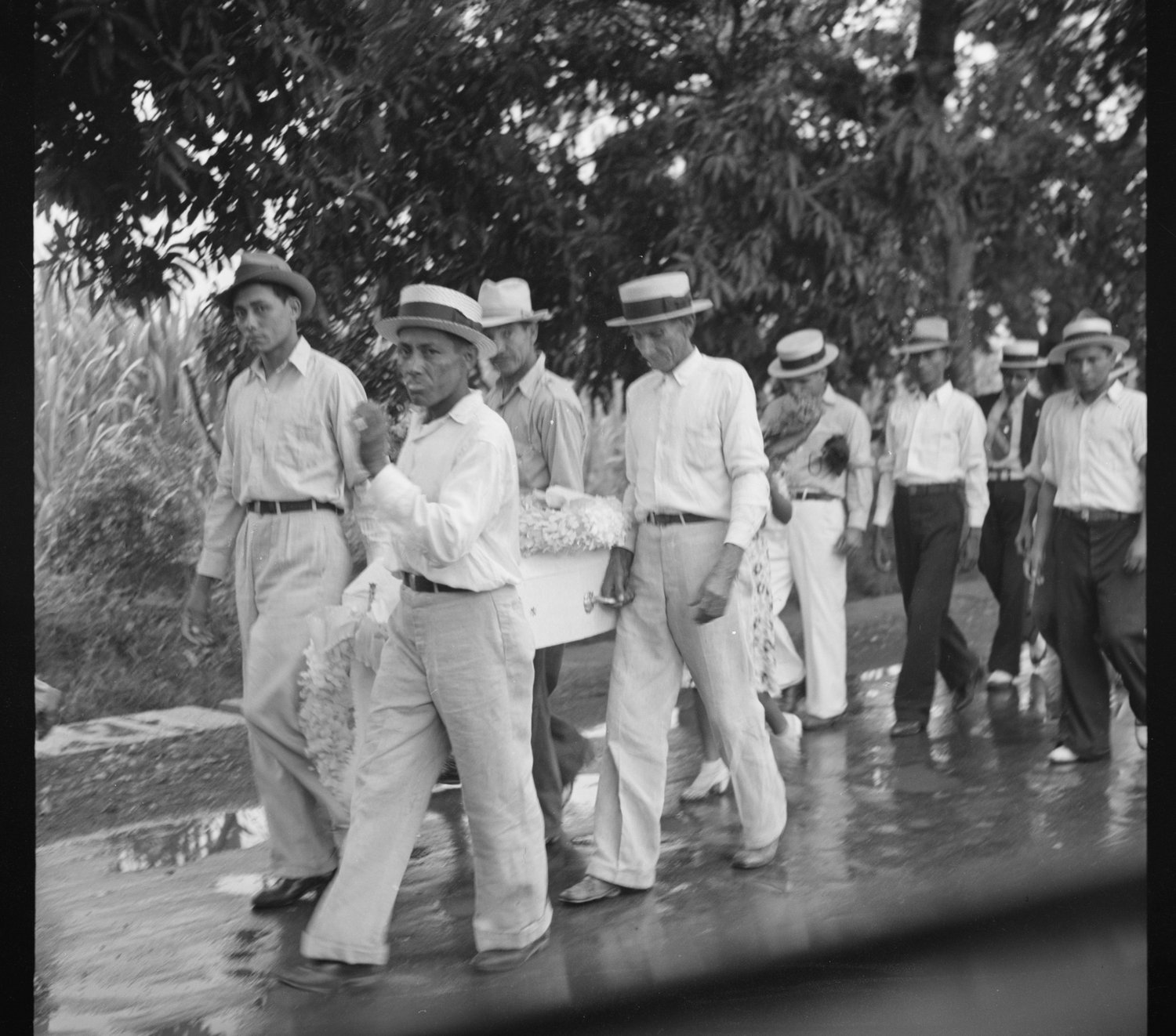
A velorio is a wake: the hours of keeping company with the dead and with the family they leave. In Puerto Rico the word reaches past funerals. A velorio de santos is a night of devotion to a saint, with no death at its center, so a song from a velorio is not always funeral music. The baquiné is the wake for a small child, an angelito, whom the Catholic tradition holds to be innocent; the recording Ricardo E. Alegría made for the Folkways album Caribbean Folk Music (1960) catches an elder leading a chorus, with spoken asides between the sung passages. In Loíza, the archive ¡Loíza Vive! at UPR Mayagüez keeps the memory of Confesor De Jesús Pizarro, who described the baquiné of his youth as song, drama and the company of neighbors, offered to console the family while honoring the child’s innocence. Historical accounts describe two sounds for these nights: inland, the cuatro, the guitar, the güiro and the maracas; on the coast, drums and handclapping. And the rosario cantado, the sung rosary, in which one voice leads and the others answer, can be prayed to keep a promise as well as for the dead; in the south of the island, the rosarios mendé were long tied to the dead, though their origins are still argued.
Grief, then the dance
In Ghana, funerals can run for days. Among the Ewe, gogodzi, and among the Asante, adowa, can give the loss its voice; later the music calls the living to gather, to dance and to renew their ties. Brass bands play too, and in Accra the La Drivers Union sends off its own with por por, music made on the squeeze-bulb horns of their vehicles, with drums and voices, heard on the Smithsonian Folkways album Por Por: Honk Horn Music of Ghana (2007), with notes by the anthropologist Steven Feld.
A single voice
The Irish caoineadh, the keen, was sung over the dead at wakes and at the graveside, most often by women: the bean chaointe (plural, mná caointe), composing aloud as she went, in a form scholars trace through texts of the seventeenth and eighteenth centuries. In 1978, interviewed by Esther Warkov at the University of Washington, the Connemara singer Joe Heaney remembered the women who lamented the dead and moved everyone present to tears: a keener mourning her own dead while she put words to the grief of the house she stood in. What survives is mostly remembered laments, sung for a collector rather than over the dead.
Music with a job to do
Some traditions give music work to do. On Jindo, an island off Korea’s southwest coast, the ssitgimgut is a shamanic rite of music, dance and theater held to release the dead person’s resentment and help the soul across. Its parts have tasks: washing and purifying the soul in one, clearing the road in another. A 1991 Seoul recording by the ensemble of Kim Dae-re, released by JVC, gives the second its name, Kil-Takkum: the clearing of the road.
The dead come home
Other traditions turn the relationship around: the dead come back, and the living get ready for them. In Mexico, Indigenous communities mark the temporary return of their dead at the end of October and the beginning of November, with offerings, flowers and visits to the graves, each community in its own way; UNESCO lists the festivity among the world’s intangible heritage. Music is part of the welcome. Mexico’s national institute of anthropology and history, INAH, documents relatives and friends playing in the cemeteries, with pieces to invite the souls, to honor them and to remember them, and in the Huasteca the season called Xantolo has instrumental ensembles of its own. Velorio fell on the last night of October, at the threshold of that season; the photograph at the top of this page was taken in Tzintzuntzan, Michoacán.
The ancestors, kept close
In Seoul, the descendants of the Joseon royal family gather at the Jongmyo shrine each year, on the first Sunday in May, for an ancestral rite of offerings, song, instrumental music and dance: officiants offer food and wine while bells, gongs, flutes and zithers play. It is a royal Confucian ceremony, nothing like a village wake, and yet its logic runs through every tradition here: attention, paid again and again, as a way of keeping someone.
Small facts to take with you
The baquiné is also written baquiní in some sources. Richard A. Waterman recorded Ramona Pizarro leading the baquiné song ‘No lo llores madre’ in Guaynabo in 1946, and the Library of Congress issued his Puerto Rican recordings as Folk Music of Puerto Rico. Ssitgim means washing in Korean. The Ghanaian scholar J. H. Kwabena Nketia published Funeral Dirges of the Akan People in 1955.
If tonight sent you reading
- J. H. Kwabena Nketia, Funeral Dirges of the Akan People (1955)
- Steven Feld’s notes to Por Por: Honk Horn Music of Ghana (Smithsonian Folkways, 2007)
- Harold Courlander’s Caribbean Folk Music, Vol. 1 (Folkways, 1960), with Ricardo E. Alegría’s baquiné
- the oral-history archive ¡Loíza Vive! at UPR Mayagüez
- the Joe Heaney Archive on death customs and the caoineadh